
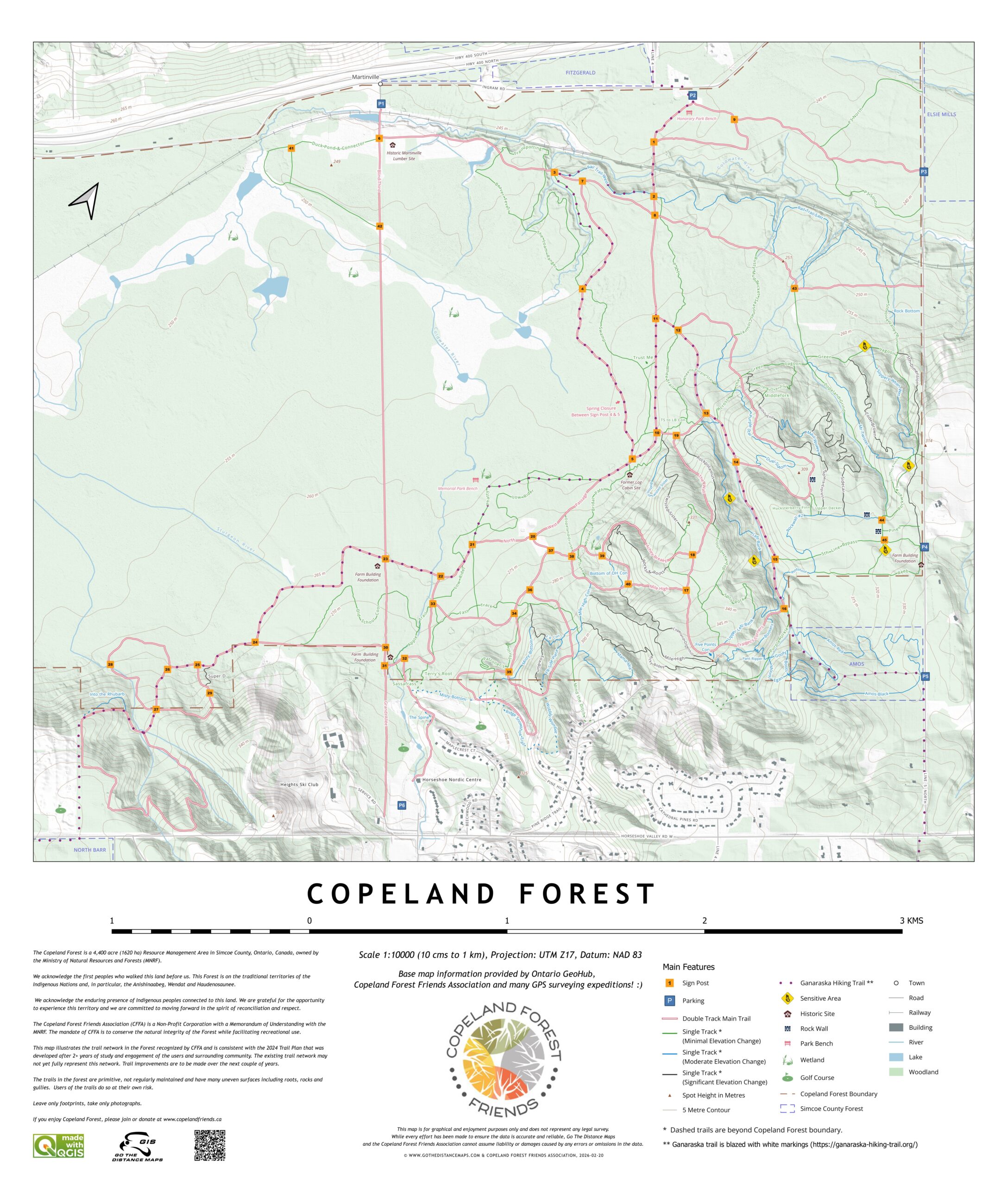
The Copeland Forest has an extensive network of dual track and single track trails that are open to all non-motorized users. The Association’s priority is to ensure the health of the forest while providing for all a wide range of recreational opportunities on these trails.
2026 Copeland Trail Plan Update
The trails in Copeland Forest provide recreational value to many users including hikers, cyclists, skiers, and horseback riders. After a 2+ year study process, CFFA released a Trail Plan in January 2024. The Trail Plan focused on the 53 km of single track in the forest and identified key issues or challenges with the trail network and made recommendations on how to address these issues. Many of the trails have been in existence for almost 20 years but were developed without the endorsement of the landowner (the Ministry of Natural Resources) and in some cases were built in ecologically sensitive areas.
Key issues/challenges associated with the trail network were identified as follows:
• Compacted soil on the trail;
• Increased and unchecked surface runoff of rain/meltwater;
• Soil erosion on sloped sections/fall-line trails;
• Tree root exposure;
• Forest fragmentation and the resultant isolation of wildlife species between trail sections;
• Disturbance of wildlife by presence of humans, dogs and horses; and
• Disruption of wet seepage areas either by log corduroy bridges and/or horse hooves.
About half of the existing trails were identified for some amount of improvement. Most of the recommended trail changes/improvements are related to mitigating wet/sensitive habitat areas or sections of trail erosion/widening. In a few cases changes are proposed due to trail redundancy including trails running parallel to one another. The Trail Plan was prepared with the review and input of the Ontario Ministry of Natural Resources.
Much has happened in the past 2 years since the Trail Plan was released.
• Confirming the singletrack trail network and trail naming.
• Production of a trail map identifying the trail network.
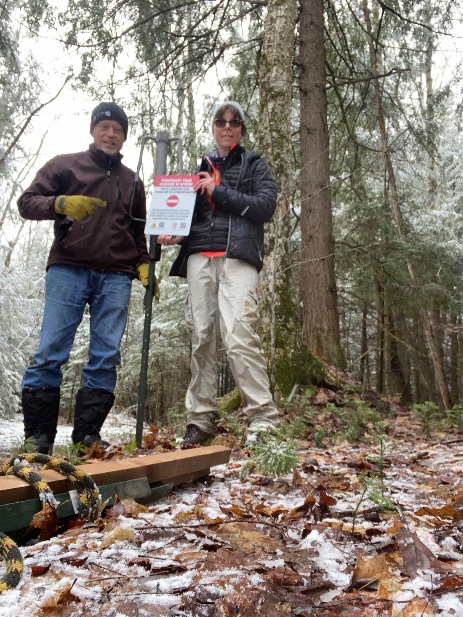
• The creation of trail closed signs (seasonal and permanent) and their installation in the forest at applicable trailheads. We have had some limited success in the closure of some trails in the forest, but challenges remain.
• Creation of some trail detours around either highly eroded sections or ecologically sensitive areas.
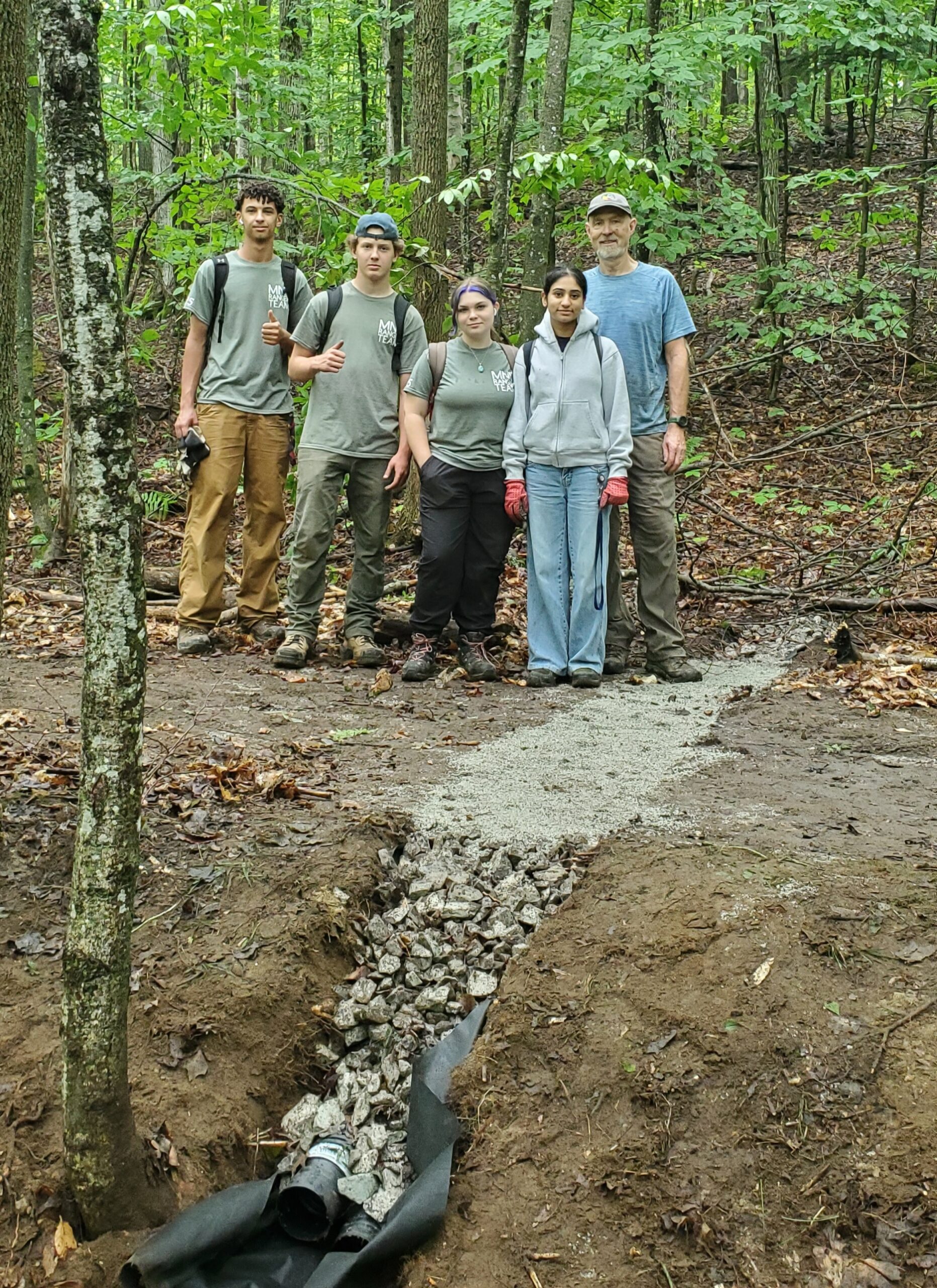
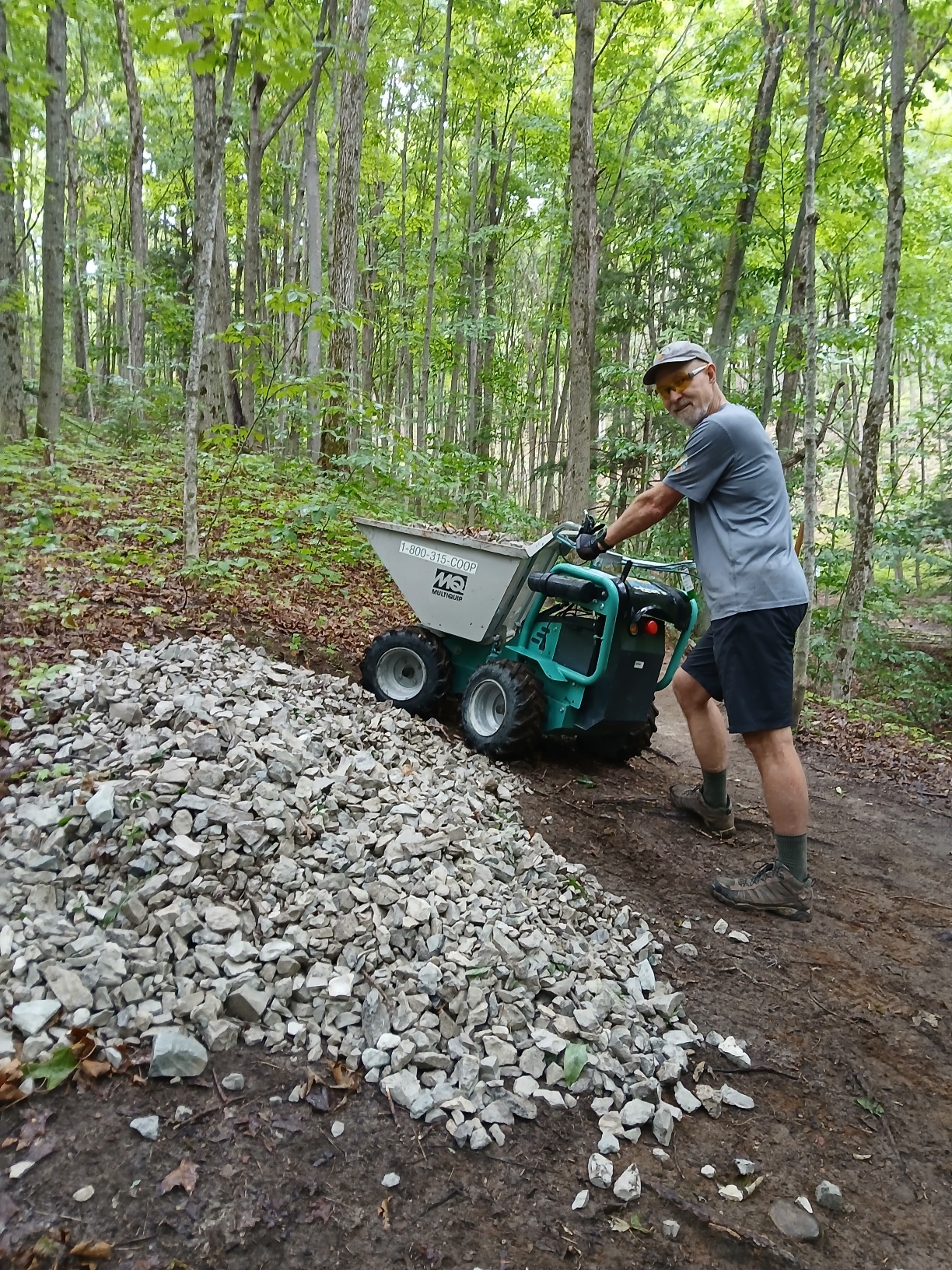
• Drainage works to address areas prone to being wet and resulting trail widening.
• Participation of MNR Youth Rangers in trail projects.
• Trail re-narrowing.
• Removal of fallen trees over trail sections including support of the March 2025 ice storm clean-up.
• Supporting wood platforms work in select locations over wet areas.
• Monitoring and responding to unauthorized trail and trail feature builds.
Implementation Challenges:
CFFA has experienced some challenges in the implementation of the Trail Plan. Key ones are summarized below:
Unauthorized Trail Builds: Although new unauthorized trail builds are occurring with less frequency than years past, we are still seeing this occurring including the building of structures (e.g. bike ramps). These activities result in ecological damage to the forest. CFFA continues to monitor these activities and any unauthorized trail builds have been closed and/or removed.
Removal of Trail Closure Signs: The Trail Plan has identified the permanent full closure of only 4 of the 53 single track trails (2.4% of the trail network) including Copeland No Name, Bomb Hole, Schnazzlberry and Treehole). In addition, some partial sections of other trails were also recommended for closure with detours (e.g. bottom of Slippery When Wet). Some forest users are of the opinion that none of the trails should be closed. And in a few cases our trail closure signs have been removed and taken by some individuals. This has required the installation of new signs at these same locations.
Continued Use of Closed Trails: Related to the above, in 2024 we also placed brush on these trails including with the support of the MNR Youth Rangers to help in their ecological remediation. The brush was removed from these trails. In 2025 our approach has been to place trail closure signs only in the hope that responsible users will respect the trail closure signs. The monitoring of these closed trails still shows some amount of tire tracks.
Trail Use During Wet Conditions: While some trails drain well and can be used shortly after spring thaw and major rain events, some lower lying trails remain wet for some time. Using these trails leads to the trail tread being impacted, mostly from bike tires and/or horse hooves. As well, to avoid the wetter sections users attempt to go around leading to a widening of the single-track trail.
2026 Trail Works Focus:
For 2026 CFFA intends to continue with the implementation of the Trail Plan. Some of our efforts in 2025 were spent on the ice storm clean-up taking away from Trail Plan implementation work. Key activities which are to be further defined include:
• Continuing to address trail sections prone to being wet either through platforms or crushed stone (as was done on Across the Green Lagoon and Rail Trail in 2025).
• Improved forest signage including maps and wayfinding arrows for recommended hiking routes.
• Monitoring trail closures and signage for it.
• Address eroded/gullied sections of trail.
• Creation of a trail work crew.
• More frequent communications regarding trail conditions and recommended use.
If you have an interest in supporting the trail maintenance activities, please let us know at info@copelandfriends.ca
_____________________________________________________________________________________________________________________________________________________
The sections below document the original Trail Plan, the Environmental Ecology Study and the member trail survey.
_____________________________________________________________________________________________________________________________________________________
Final Trail Plan published Jan 30, 2024
An environmental Assessment of the trails
An extensive environmental impact review of the trails was completed and used as input to the Trail Plan.
Read the Environmental Ecology report here.
Members Trail Plan Survey Results
In 2022 a survey of Forest users was completed to capture opinions and thoughts on the state of the trail network. This results of this survey was used by the Trail Committee as input to the Trail Plan. Read the Survey Results here.